Oops! The Team Asked How to Calculate the Story Point
If you were to ask me as a Scrum Master what is the most challenging aspect of explaining to teams (or understanding myself when I first heard of it) is, my answer would undoubtedly be how to estimate user stories, and on what basis to assign Story Points. (Coming in second would be how to break down a story into small enough pieces to be completed within a single sprint – but I’ll talk about that in another post 😊).
Although I’ve been finding the #NoEstimate movement more appealing lately, many organizations still predominantly use velocity and story point concepts. That’s why I felt the need to address this topic. What triggered me to write this article was an email I received three days ago, which wonderfully explained the concept of story points, from dear Daria Bagina.
And so, we begin…”
A Story Point is a concept that represents the size (magnitude) of a story. The reason for the need of this concept is to assist the team in determining how many stories can fit into a sprint backlog. During sprint planning meetings, teams refine and estimate the size of well-defined (with potential for further development) user stories by assigning them points. This helps them decide which tasks to include within the sprint scope. The confusing part is how these points are calculated. When assigning points to stories, team members often consider the ‘man-day’ or ‘man-hour’ approach in their minds, as these are the most commonly used and familiar ways of measuring size in projects. Some sources – including ChatGPT 😊 – may suggest that 1 story point corresponds to tasks taking up to 8-10 hours, but this isn’t entirely accurate. Assigning Story Points involves giving stories a relative size compared to one another (Size ≠ Md or Mh Effort).
Let’s illustrate with the example from Daria Bagina:
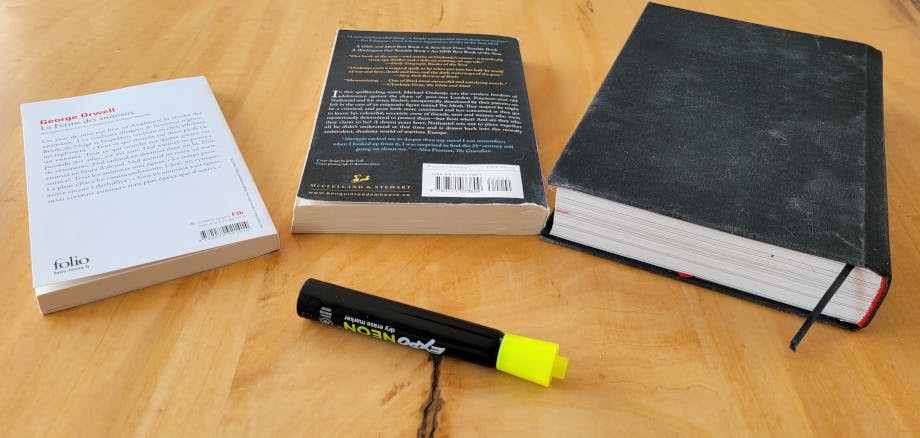
Let’s say we are going on a 2-week vacation and we want to take a book with us to read and finish during the holiday. By looking at the books in the image below, we will decide which one to take.
When making this decision, what do I consider?
• I think about how fast I read.
• I open the books and look at the font, layout, and picture-to-text ratio to understand their complexity levels.
• I review my vacation plan to assess how much reading I can do each day.
Considering all of these factors; I can confidently say that the book on the left is short enough, and I can definitely finish it in 2 weeks. The book in the middle is about 1.5 or 2 times the size of the one on the left; it seems reasonable, but I’m not entirely sure. The book on the right is at least 4 times bigger than the one on the left. When I looked inside, I could see that the font was quite dense. Therefore, I definitely can’t take it. Thus, I eliminated the book on the right.
Left or middle?
Let’s say I have busy tourist visits during the day, and I know I’ll only read books in the evenings. In that case, I’ll choose the book on the left. But let’s imagine I have nothing to do other than lounging on the beach. In that scenario, I would choose the book in the middle.
When making these decisions:
• Did I need to know the exact number of pages in each book? – No
• Did I have to measure the exact font size in each book to decide? – No
• Did I calculate the exact hours needed to finish reading each book? – No
• Did I need to know exactly how many hours I have for reading throughout the vacation? – No
So, what did I do?
• I didn’t calculate the hours needed to finish a book; I simply evaluated each book by comparing them.
• Later, to get a general idea, I considered my past experience with reading and how much I usually complete during certain time periods.
• I didn’t think in terms of hours, as I won’t be sitting in front of the book all day without eating, sleeping, or going to bathroom.
I can hear some of you saying, “I look at how many pages the book has, right?” Of course, you can check the page count to get an idea. However, verifying whether there’s text on every page and how much text is there requires going through each page, which would take quite some time. Plus, even doing that might not guarantee how many hours it will take to read each book.
When giving Story Points, we’re essentially trying to do exactly what’s described in this example. Think of Story Points as representing the size and complexity of reading a book.
In our example, we could say that the book on the left is 1 Story Point, the one in the middle is 2 Story Points, and the one on the right is 5 Story Points.
If using the Fibonacci Series for assigning points feels complex, you can also use a scale from 1 to 5 or techniques like t-shirt sizes (S, M, L).

Leave a Reply