
Before reading this article, I recommend researching and learning the following concepts, which I might write about in the future 🙂
• User Story
• INVEST Technique
• Writing Acceptance Criteria Techniques
A User Story in single sentence is a scenario where a user describes a functional or technical requirement they want in a product.
If you work with Agile frameworks, you often hear the advice to split a single story into multiple smaller stories. This advice isn’t arbitrary; it has several benefits:
- Clarity: Smaller stories are less complex, making them easier to understand. Prioritization becomes simpler. Team members can work on stories concurrently or choose to focus as a team on one small piece at a time.
- Better Estimation: Splitting stories allows for more accurate estimation. Estimating the time and resources needed for smaller stories is more precise, improving overall planning and management.
- Speed: Smaller stories are more likely to be implemented faster, leading to quicker deliveries.
- Ease of Testing: Smaller stories are easier to test, resulting in higher quality, fewer errors, and greater user satisfaction.
There are various techniques to split stories into smaller pieces. In this article, I will discuss the technique of Splitting Using Acceptance Criteria.
This approach involves breaking down stories into smaller narratives by focusing on specific acceptance criteria or test scenarios. It enables the team to work on different acceptance criteria simultaneously and deliver them independently.
To illustrate this concept further, let’s consider an example:
Suppose our story is, “As a visitor to the ABC airline ticket booking website, I want to compare flight schedules of different airlines.” This is essentially a flight listing feature. We can’t simply hand this story to the development team as is. First, we need to define the system’s behaviors, i.e., functional requirements. We usually do this during Refinement meetings, where we also roughly define the user acceptance criteria.
Now, let’s write the acceptance criteria for our story. I’ll use the Given-When-Then scenario approach for this.
Given that the Visitor selects Departure and Arrival Airport information,
When they want to list Non-stop flights,
Then all the airline companies offering non-stop flights between the selected departure and arrival points should be displayed on the screen.
These acceptance criteria indicate the presence of different types of flights: non-stop and connecting flights. Based on this, we can split our story into two sub-stories.
Main Story: Flight Information Listing
Sub-stories:
• Listing non-stop flights
• Listing connecting flights
Let’s say there are discount campaigns available for connecting flights at certain times. In this case, we can further break down the stories:
• Listing only discounted flights
• Listing all flights

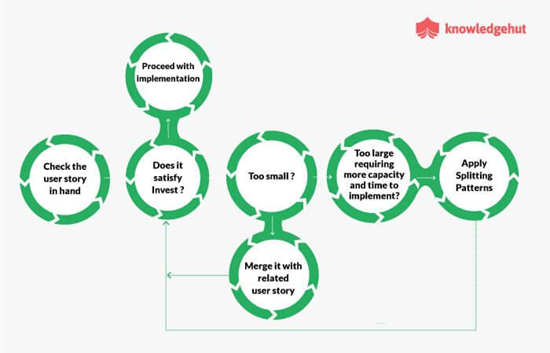
Using the INVEST technique helps you to assess whether you have split stories into appropriately small pieces or if you have overly fragmented them.

Leave a Reply