Unsupportive Top Management
In large organizations, top management support is essential for a team to be truly agile. “Leaders” in business and technology units should encourage their teams to create value together.
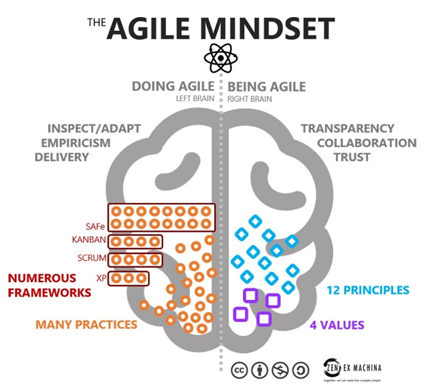
In order to do this, first of all, their way of thinking and mindset must be agile. Not forget that “Agile is a mindset”.
In the absence of such support, the Scrum Master may find it difficult to motivate, mentor and coach the team. In order to overcome this difficulty, more senior management is expected to take action instead of the Scrum Master. It is up to the Scrum Master to make this need visible.
Managers/leaders with agile mindset move their teams to agility in 4 steps:
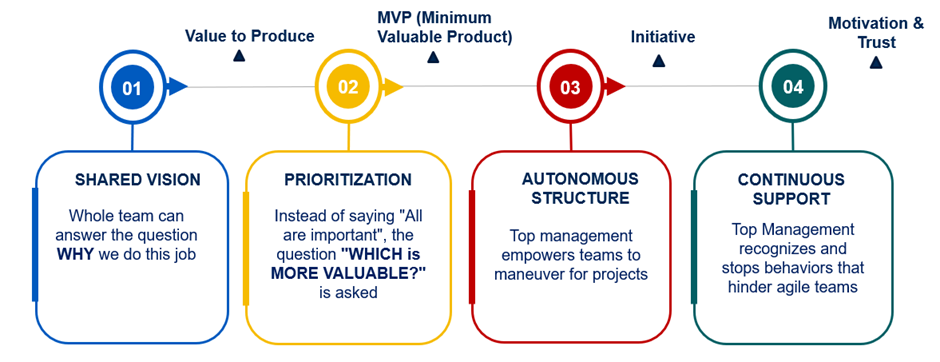
1. Shared Vision
The whole team should know the answer to the question WHY we are doing this job. Knowing this answer by everyone is related to the senior management’s ability to adopt its vision to all its employees. The team’s commitment increases to the extent that it knows the expected value of the work it will produce and its connection with the company goals.
2. Correct Prioritization
According to The Standish Group Chaos 2014 Project Smart report, while 45% of the features of a technology product are never used, only 7% are used continuously. This means that not all features in the product are valuable. So why waste time with features that don’t produce value?
Leaders should also be able to say no to good ideas and ask their teams “Which is more valuable?” Instead of waiting for it to be perfect, they should encourage the team to move forward with the MVP (Minimum Viable Product) approach.
3. Autonomous Structure
Managers should empower teams to maneuver through projects. The behavior of ‘Be agile as teams, but continue to move forward in decisions in a hierarchical order, at least under our control as senior management’ is at odds with agility.
4. Continuous Support
Managers/Leaders with an agile mindset:
• Speaks the same language as the authorized team.
• Recognizes and stops behaviors that hinder agile teams.
• Sets the goal of employees to create value and measures performance over the value produced.
• Makes all stakeholders feel that they are part of a team and that it is necessary to focus on ‘how to solve’ possible faulty or delayed work together. Asks the question “How do we solve it?” before the question “Who did it originate from?”
• Gives feedback about the product.
• Celebrates success with all stakeholders.
In organizations with managers/leaders with agile mindset, it remains for the Scrum Master to work to bring his team to a better performance in each sprint.

Leave a Reply